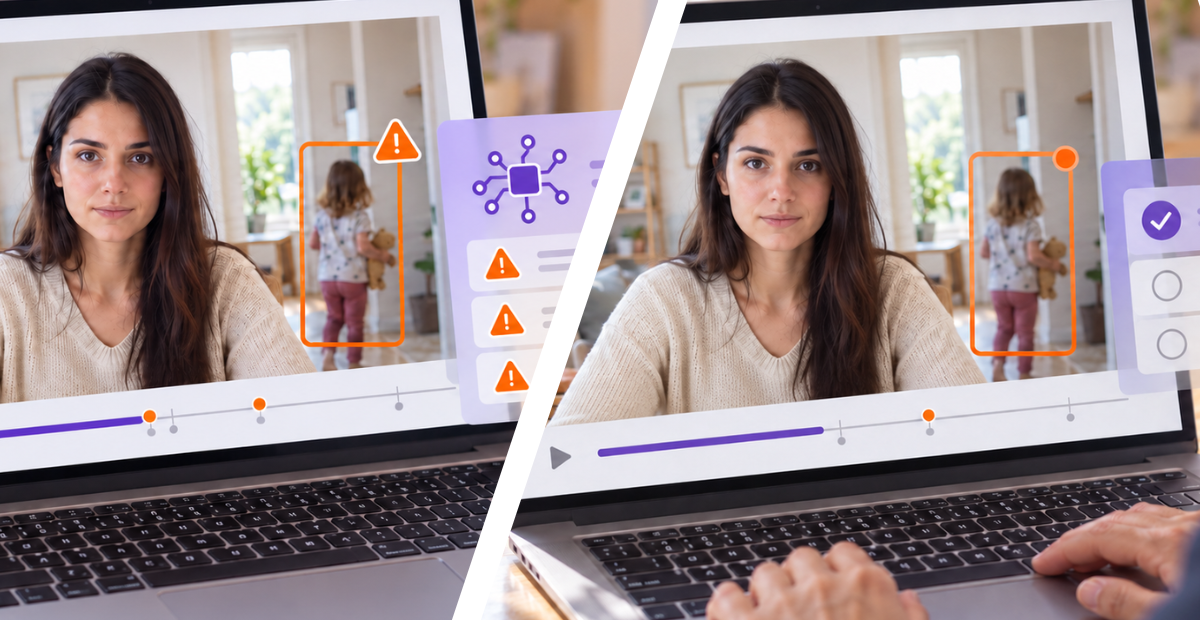
A candidate is taking an online exam at home when their young child briefly walks into the webcam’s view. The proctoring system detects another person and flags the moment.
Was the candidate cheating?
A trained human reviewer can examine what happened: a child wandered into the room, no assistance was exchanged, and the candidate continued the exam. With that context and the exam’s rules, the reviewer can distinguish an accidental interruption from a violation.
AI can flag unusual activity. That does not make the activity proof of cheating.
Where AI-only proctoring falls short
Automation helps monitor exams at scale and identify moments that deserve attention. The challenge comes when those signals are treated as conclusions.
Looking away, speaking aloud or briefly disappearing from view can have several explanations. A candidate might be thinking through a question, using an approved accommodation or adjusting their webcam. Deciding whether a rule was broken requires more than recognizing a pattern.
Technical limitations can also affect candidates differently. A 2022 University of Louisville study involving 357 students found that the evaluated proctoring system detected faces for an average of 78% of exam time for students with darker skin tones, compared with 92% for those with lighter skin tones. The study examined one system using 2020 exam data, so these figures are not a current industry-wide error rate. They illustrate why automated outputs need scrutiny.
Unreviewed alerts also create work for administrators, who must investigate ambiguous events and explain them to candidates.
What human review adds
A hybrid model combines automated detection with trained human review.
Automation identifies potential concerns. Reviewers examine the available evidence, what happened before and after the event, and the applicable exam rules. Approved accommodations and permitted resources should inform that assessment.
The reviewer can then dismiss an unsupported concern or document evidence of a violation. This contextual evaluation is central to the human review process used by Integrity Advocate, the online proctoring solution integrated into uxpertise LMS and uxpertise XP.
Human review is not infallible. Its value depends on training, consistent standards and sufficient evidence. Those safeguards help turn an alert into a considered finding.
Reliable results need an explanation
If a candidate challenges an integrity decision, an automated risk score provides limited answers.
A defensible decision is one the organization can explain: what occurred, which rule applied, what evidence was reviewed and why the conclusion was reached. Documented human review provides a basis for responding to questions and reconsidering a finding when appropriate. This connection between evidence and reasoning is central to Integrity Advocate’s approach to defensible outcomes.
That finding concerns the integrity of the exam session. It is separate from the candidate’s academic score.
A Canadian example: National Payroll Institute
According to Integrity Advocate’s published case study, the National Payroll Institute moved from incident decisions taking weeks to occurring within 48 hours, supported by documented evidence.
The case study also reports that average monthly academic integrity incidents dropped from 86 to 37 after combining Integrity Advocate’s platform with proactive integrity education. That improvement reflects the combined approach; it does not isolate the effect of human review alone.
Ask what happens after a flag
When evaluating online proctoring, ask who reviews potential violations, whether they consider exam rules and accommodations, and how findings are documented and challenged.
Neither AI nor people can guarantee that every violation will be detected. A well-designed hybrid process adds context, accountability and a stronger basis for decisions that affect grades, certifications and careers.
Explore online proctoring with human review through uxpertise. Speak to our team.